Search is moving beyond the traditional model of typing a keyword into Google, reviewing a list of web links, and visiting several websites. AI-powered search platforms such as Google AI Overviews, Gemini, ChatGPT, and Perplexity are changing how people discover information, compare businesses, and explore available options.
This shift is making Agentic SEO an important topic for businesses preparing for 2027. But does Agentic SEO mean traditional SEO is becoming outdated? Not exactly. Traditional SEO will continue to provide the technical and content foundation, while Agentic SEO will add new ways to make websites understandable and useful to AI systems.
Traditional SEO focuses on improving a website’s visibility in SERPs (Search engine result pages). It includes keyword research, comptitor analysis, on-page optimisation, technical SEO, internal linking, content optimization, backlink analysis, website page speed, mobile responsiveness and other factors that help search engines discover and understand a website.
For example, a business offering SEO services may create a page targeting terms such as “SEO services in Delhi NCR” and optimise the Meta title, meta description, url structure, headings, sub heading, content optimisation, internal links and technical SEO elements around that search intent.
These are the most important foundational elements of traditional SEO. Generative AI search features continue to rely on its existing Search ranking and quality systems, meaning SEO remains relevant even as search experiences evolve.
Agentic SEO takes the concept of search optimisation a step further.
Instead of focusing only on helping a page rank for a keyword, Agentic SEO focuses on making a business, website and its information easier for AI systems and agents to understand, evaluate and potentially recommend.
AI agents can handle multi-step research tasks. Rather than simply returning links, an agent may search multiple sources, compare information, assess options and help a user reach a decision. This means a brand needs to provide information that can be clearly interpreted across different digital environments.
In simple terms:
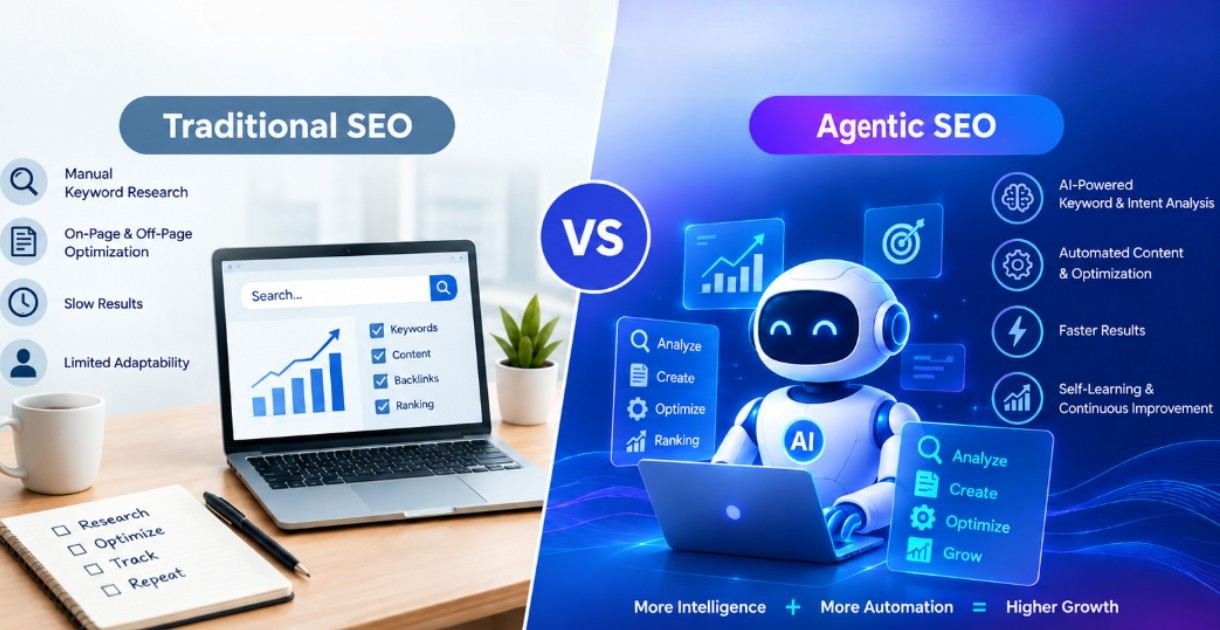
Traditional SEO: How can this page rank for a search?
Agentic SEO: How can AI systems understand, cite, compare, and recommend this brand?
Difference Between Agentic SEO vs. Traditional SEO in 2027 –
Traditional SEO focus on keyword rankings, impressions, clicks and organic traffic. Agentic SEO expands the focus to include AI citations, brand mentions, visibility in AI-generated answers, entity recognition and interactions that may happen without a traditional website visit.
Keywords will remain important, but relying only on exact-match phrases will become less effective.
AI systems can interpret conversational questions and related concepts. Businesses therefore need content that answers complete user needs rather than targeting a single keyword throughout a page.
A strong strategy should address related questions, comparisons, use cases, definitions, costs, processes and real-world problems.
Traditional SEO often asks whether a website appears on page one.
With Agentic SEO, another question becomes important: Does the brand appear when users ask AI systems for recommendations or information?
A website could receive fewer clicks while still influencing customers if its information is being referenced in AI-generated answers.
This creates a wider definition of search visibility across Google Search, AI features and other AI-powered platforms. Current SEO research also points toward visibility across multiple search surfaces rather than relying exclusively on traditional rankings.
Content is still important and needs to be useful to users, but its structure also matters.
Clear headings, descriptive page titles, semantic HTML, internal links, structured data and well-organised information can help systems interpret a website.
Structured data can provide search engines with clearer information about entities and page content, although it does not guarantee a ranking or AI citation.
Backlinks remain an important traditional SEO signal, but AI visibility can involve a broader ecosystem.
AI systems may address information about a company through websites, publications, communities, reviews, social platforms, videos and other sources.
This makes consistent brand information and genuine third-party recognition increasingly important.
Traditional SEO campaigns often focus heavily on organic sessions and conversions.
Agentic search introduces another possibility: an AI system may provide an answer without sending the user to a website.
For businesses, this means measuring more than traffic. Brand mentions, AI citations, qualified leads, branded searches and assisted conversions can become useful indicators alongside traditional SEO metrics.
The best approach is not to abandon traditional SEO. Instead, businesses should build on it.
Start with technically sound websites, useful original content, logical site architecture, strong internal linking and authoritative information. Then make important business information easy to understand and verify.
Content should answer real questions rather than simply target search terms. Include specific facts, original insights, examples, pricing information where appropriate, service details and clear explanations.
Google also warns that using generative AI to create large volumes of pages without adding value can violate its spam policies. Accuracy, relevance, originality and human review therefore remain important when AI is used in content production.
Businesses should also monitor how their brand appears across AI-powered search platforms. Search visibility is becoming broader than a traditional ranking report.
Absolutely. Agentic SEO should not be treated as a replacement for traditional SEO, including Onpage SEO, technical SEO, Content SEO, or Offpage SEO.
A strong 2027 strategy will therefore combine both approaches:
Traditional SEO + AEO + GEO + Agentic SEO = broader search visibility
Traditional SEO creates the foundation. AEO (Answer engine optimisation) helps content answer questions clearly. GEO (Generative engine optimisation) focuses on visibility within generative search experiences. Agentic SEO extends this approach toward AI systems that can research, compare and potentially take actions for users.
The difference between Agentic SEO and Traditional SEO in 2027 will not be about choosing one over the other. It will be about expanding the definition of optimisation.
Traditional SEO helps search engines discover and rank web pages. Agentic SEO focuses on making a brand’s information understandable, trustworthy, accessible and useful within AI-driven search.
The future of SEO is not just about achieving top rankings; it is about building credibility across the platforms where customers search for information, ask questions, and interact with AI systems.

Clear answers to common questions about
our process, pricing, timelines, and support.

Traditional SEO focuses primarily on improving keyword rankings and website visibility in search engines. Agentic SEO expands this approach by helping AI systems understand, evaluate, cite, and potentially recommend a brand during AI-assisted research.
No. Traditional SEO will remain an important. Technical SEO, content optimization, site structure, internal linking, authority and other established strategy will continue to support visibility across modern search experiences.
Businesses can start by publishing original content, improving website structure, using structured data, maintaining consistent business information, building authority, and tracking visibility across AI-powered search platforms.
Yes, but keyword optimisation should not be the only focus. Businesses should also focus on search intent, related questions, entities, topics and conversational queries.
No. AEO generally focuses on answering questions in search and answer engines, while GEO focuses on visibility in generative search experiences. Agentic SEO extends optimisation toward AI agents that can research, compare and potentially perform tasks.
Businesses can track keyword rankings, clicks, conversions, AI citations, brand mentions, qualified leads, and visibility across AI-powered search platforms.
Agentic SEO may cost more than Traditional SEO due to additional AI visibility tools, automation and content optimisation requirements. Costs depend on business goals and project scope.
Costs depend on website complexity, content creation, AI monitoring tools, technical SEO improvements, automation and ongoing optimisation.